
Our Responsibilities During the Occultation
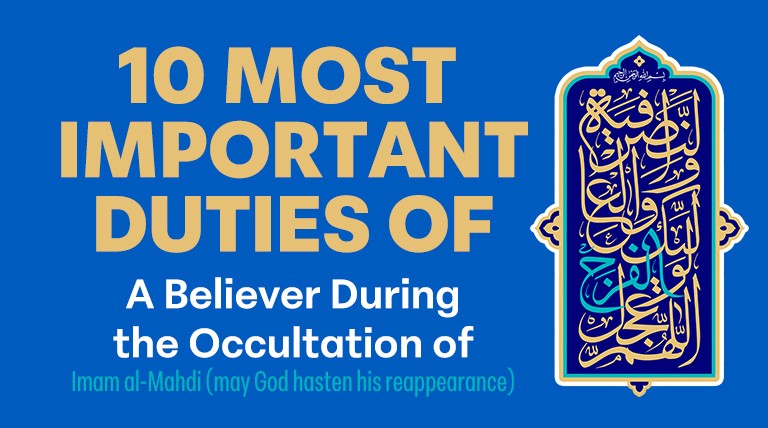
The main focus of my discussion is on the duties we have during the occultation of Imam Mahdi (عجل الله تعالی فرجه الشریف). Before I present these duties, I must mention that the story of Imam Mahdi spans the entire history of Islam, even before the time of Islam itself. Although Imam Mahdi was born in the middle of the 3rd century AH, the topics related to him must be traced back to the time of the Prophet Muhammad (صلى الله عليه وسلم). On the night when the Prophet ascended to the heavens, when he saw the light of Imam Mahdi, he said: "Tuba liman ahabbah, happy is the one who loves and believes in this Mahdi."
Especially in the period of his appearance (عجل الله تعالی فرجه الشریف) and the establishment of his just government, where beauty, perfection, governance, and might come together, Imam Ali (علیه السلام) was deeply eager. As Asbagh bin Nabatah narrates, I once sat with Amir al-Mu’minin (علیه السلام) who was sitting on the ground, and he said: "Ya Shawqa Ilay Ru’yatihim fi Hāl Zohūr Dawlatihim!" – "How much I long for the sight of them, in the time of the appearance of their government!" (Al-Kafi, vol. 1, p. 235)
A narrator mentions that one day, on an Eid, I came to Imam Sadiq (علیه السلام). Facing the qiblah, he was shedding tears, saying: "Sayyidi, Ghaybatuka nafat ruqādi wa dayyaqat ‘alayya mihādī wa ibtazza’t minni rāhat fu’ādī." Imam Sadiq (علیه السلام) expresses his sorrow over the occultation of Imam Mahdi, even though he was still many years away from being born.
Books regarding Imam Mahdi were written even before his birth. For example, Hassan bin Mahboob wrote about him during the time of Imam Reza (علیه السلام), and even Sahih Muslim and Sahih Bukhari, before the birth of Imam Mahdi, contain chapters about him.
The appearance of Imam Mahdi is an indisputable fact in Islam, and even Ibn Taymiyyah, a staunch opponent of Shia, includes narrations about Imam Mahdi in his Minhāj al-Sunnah. Shafi’i Ganjī also authored a book titled Al-Bayān Fi Akhbār Sahib al-Zamān, stating in the preface that the book is free from Shia narrations.
When Dabīl Khazā'ī visited Imam Reza (علیه السلام), he recited a poem about an Imam who will rise in the name of Allah. Imam Reza responded, saying: "Dābil, the spirit of truth has placed this poem upon your tongue."
There is, however, one point of disagreement between us and the Sunnis regarding the birth of Imam Mahdi. But the matter of his appearance and his global uprising is supported by numerous authentic narrations.
Abu Khalid Kabīlī narrates that when he was with Imam Sajjad (علیه السلام), the discussion turned to the subject of the Imam of the Time, and Imam Sajjad said: "O Abu Khalid, the people of the time of his occultation who believe in his Imamate and await his appearance are the best of all people, because Allah has given them wisdom and understanding, and the occultation is like the manifestation for them. They are like the fighters in the presence of the Prophet Muhammad (صلى الله عليه وسلم), they are the true sincere ones, and our true Shia. Their waiting for the relief is one of the greatest acts of relief." (Bihar al-Anwar, vol. 52, p. 122)
We must feel his presence. We are not just waiting for his appearance, but for his presence, even if it is unseen. There are many things we cannot see, like gravity, yet they are present. We should know that Imam Mahdi is aware of our actions, and that he may be present in our gatherings.
In Bihar al-Anwar, it is narrated that a man named Ramila fell ill and was unable to attend the Friday prayers for several days. He says that one Friday, after performing Ghusl (ritual purification), he came to the mosque. After the prayer, Imam Mahdi appeared to him and asked how he was doing. The man explained that he had been ill, and Imam Mahdi replied: "Do you think we did not know you were ill? We are saddened when our Shia are ill, when they pass away, and we are happy when they are happy. Nothing of what you do is hidden from us."
Imam Sadiq (علیه السلام) also said that three times a week, the deeds of the people are presented to him: on Monday and Thursday evenings, the beginning of each month, and the middle of Sha’ban. If we are aware of this, we will be more attentive to our actions.
In one story, the son of Mahziar wept continuously until, during one of his travels to Mecca, someone came to him and asked why he was crying so much. He explained that he was seeking the Hidden Imam. The man replied: "Your actions have hidden the Imam from you." He then led him to a desert, where a tent was set up, and the Imam was present. When the Imam spoke to him, he said: "You have delayed our meeting due to your neglect of the weak, your lack of mercy, and your heedlessness in your wealth."
Imam Mahdi also wrote a letter to Shaykh Mufid, calling him a brother, and said: "If our Shia’s hearts were united, and they honored their promises, the delay in our meeting would not be so long."
A hypocrite is defined by three characteristics: speaking lies, breaking promises, and betraying trusts. The greatest trust is that of the Imam: "Peace be upon you, O Trust of Allah on His Earth."
Finally, Imam Sadiq (علیه السلام) instructed: when you offer the qunut in the Friday prayers, dedicate it to Imam Mahdi, and pray for him. Several narrations from the Imams emphasize this.
Thus, we must conduct our lives with the awareness that we are not merely waiting for the Imam's appearance but are also spiritually present with him in every moment.


Comments
No comments yet. Be the first to write one.
Comments are closed.