
Hajj: A Comprehensive Academic Study
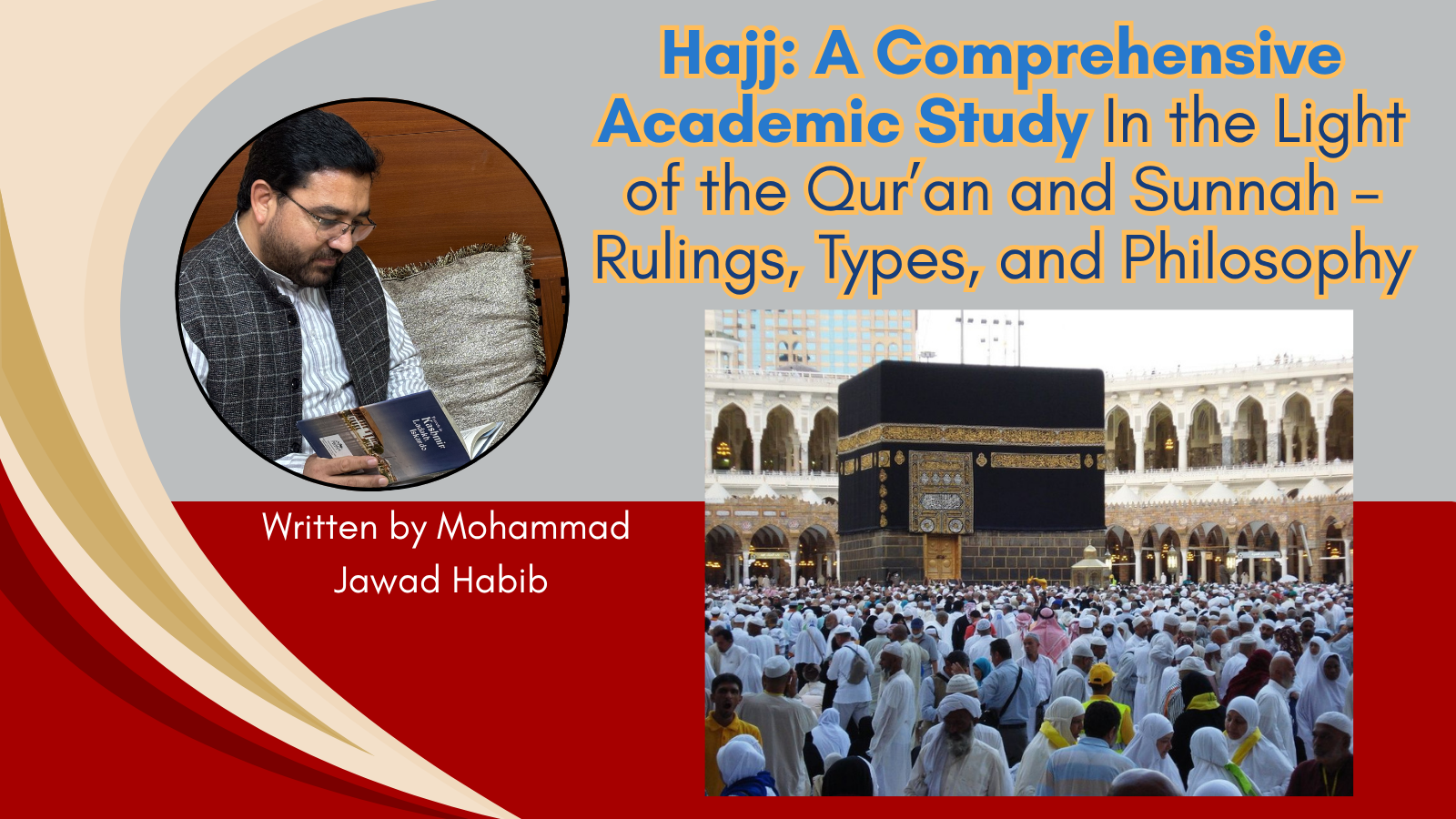

Hajj: A Comprehensive Academic Study
In the Light of the Qur’an and Sunnah – Rulings, Types, and Philosophy
By: Muhammad Jawad Habib
Introduction
Hajj holds a unique position among Islamic acts of worship. It serves not only as a means of spiritual purification for the individual but also as a symbol of unity and strength for the Muslim Ummah. The Qur’an, Sunnah, and the teachings of the Ahl al-Bayt (peace be upon them) elaborate on the virtues, philosophy, types, and detailed rulings of Hajj. This paper provides a concise academic review of these aspects to present the essence and significance of Hajj in a research-based and comprehensible manner.
I. The Importance of Hajj
Hajj is a form of worship that fosters unity among Muslims and instills reverence even in their adversaries.
Key Points
- Hajj is the foundation of faith and a symbol of Islam (Imam Ali, Nahj al-Balagha, Book 47).
- Imam Ali (peace be upon him) stated: “O Allah! O Allah! Keep your house (Ka’bah) populated as long as you live; for if abandoned, calamity will follow immediately.”
- Imam al-Sadiq (peace be upon him) said: “As long as the Ka’bah exists, the religion will remain established” (Wasā’il al-Shīʿah, vol. 8, p. 14).
- Even the enemies of Islam recognized Hajj’s significance, acknowledging that victory over Muslims is impossible while Hajj is maintained.
II. Key Rulings of Hajj
1. Intention and Sincerity
- Hajj and ‘Umrah must be performed solely for the sake of Allah.
2. In Case of Illness or Obstacles
- If a pilgrim cannot complete the rituals due to illness or external obstacles, they may offer a sacrifice (Hady) to exit Ihram.
- Only after the sacrifice can one perform Halq (shaving the head) or Taqsir (trimming hair or nails).
3. Expiation (Kaffara)
- For those unable to offer Hady: three days of fasting, feeding six to ten needy people, or sacrificing a sheep.
- For Hajj al-Tamattu’, the sacrifice is obligatory; if impossible, ten days of fasting are required (3 during Hajj, 7 upon return).
4. Residents of Mecca
- Hajj al-Tamattu’ is not obligatory for those living in Mecca or nearby; they perform Hajj al-Qiran or Hajj al-Ifrad.
III. Types of Hajj and Hajj al-Tamattu’ Rituals
Types of Hajj
- Hajj al-Tamattu’: For those living 48 miles (approx. 96 km) or more from Mecca; perform ‘Umrah first, then Hajj.
- Hajj al-Qiran: For those living closer; combine Hajj and ‘Umrah in one Ihram with Hady.
- Hajj al-Ifrad: For those living close; perform Hajj first, then ‘Umrah, without Hady.
Key Rituals of Hajj al-Tamattu’
- Entering Ihram at the designated Miqat, reciting Talbiyah.
- Tawaf around the Ka’bah seven times and performing two Rak‘ahs at Maqam Ibrahim.
- Sa’i between Safa and Marwah seven times.
- Taqsir and exiting Ihram.
- Re-entering Ihram for Hajj, standing at Arafat, overnight at Muzdalifah.
- On Eid al-Adha (10th Dhul-Hijjah): stoning Jamrah Aqabah, sacrificing Hady, and shaving the head.
- Performing Tawaf al-Ziyarah, Sa’i, and Tawaf al-Nisa.
- Stoning the three Jamarat on 11th and 12th Dhul-Hijjah, staying in Mina overnight.
These rituals provide spiritual purification, historical continuity, and serve as symbols of social unity and personal discipline.
IV. Discussion on the Alleged Abrogation of Hajj al-Tamattu’
- Qur’an and Sunnah indicate that Hajj al-Tamattu’ remains valid until the Day of Judgment.
- Numerous traditions in both Shia and Sunni sources confirm its continuity, including Sunan al-Kubra by Ahmad ibn Hanbal, Sunan al-Tirmidhi, Sunan Ibn Majah, and Sahih Muslim.
- Some, such as Caliph Umar ibn al-Khattab, objected to combining Hajj and ‘Umrah in Tamattu’ (Mut‘ah), but the majority of scholars consider Hajj al-Tamattu’ the preferred form.
- Only the Prophet ﷺ has the authority to abrogate a ruling; thus, dismissing Hajj al-Tamattu’ based on non-Prophetic opinions is invalid.
Conclusion
Hajj is a comprehensive act of worship that fosters spiritual purification, social unity, and the strengthening of Islam. The Qur’an and Sunnah provide clear guidance on its rulings, and Hajj al-Tamattu’ is especially prescribed for those living far from Mecca. Understanding the purposes of Hajj — piety, spiritual discipline, and communal harmony — allows Muslims to fully benefit from this sacred ritual.
References
- Nahj al-Balagha, Book 47, Imam Ali’s Will.
- Wasā’il al-Shīʿah, vol. 8, p. 14, Chapter on the Preservation of the Ka’bah.
- Majma‘ al-Bayan, vol. 1, p. 290.
- Al-Tafsir al-Kabir, vol. 5, p. 152.
- Sunan al-Kubra, Ahmad ibn Hanbal; Tirmidhi; Ibn Majah; Sahih Muslim.